 CAD
 USD

 We Ship across CANADA & USA.
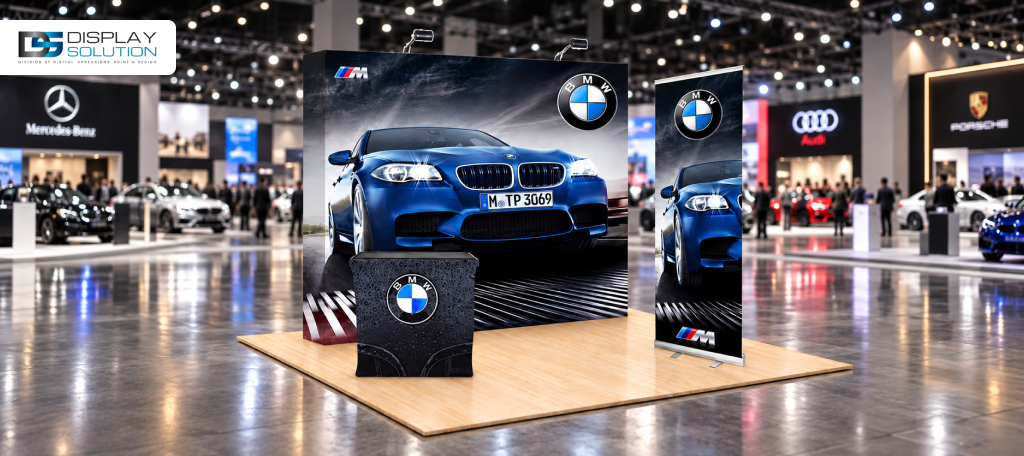
The right conference display banners depend on four things: your booth dimensions, the direction attendees approach from, the message you need to communicate, and how often you travel with the display. At a small conference table, one well-placed banner may be all you need.
A larger booth usually works better with several coordinated display surfaces, each doing a different job.
Choose Conference Booth Banners Around Your Available Space
Your allocated booth space and your usable display space are rarely the same. Once you add a table, chairs, a monitor, product samples, and room for staff to move, the floor area left for conference booth banners can shrink quickly.
Start by mapping everything that must fit inside the booth, then look at what remains. Check the available height and width, any venue restrictions on freestanding displays, and whether attendees will approach from the front or the side. A table in a hotel ballroom is a very different setting from a standard booth on an exhibition floor.
The right banner fits the booth without blocking movement, crowding working space, or hiding essential messaging. A company with a small hotel conference table may need only one retractable banner beside the table.
An exhibitor with a larger booth might use a primary backdrop plus supporting banners that carry separate messages. Comparing conference banner stand options side by side helps you see which formats suit your footprint.
Match Banner Dimensions to Different Conference Booth Sizes
Banner dimensions only make sense when you compare them with the space left after furniture and people are in place. Sizes vary by product, so confirm the exact specifications of any stand you are considering.
Table-Only Conference Spaces
Many conferences give exhibitors a single table rather than a full booth. Tabletop banner stands introduce your brand vertically without taking over the limited table surface. A narrow freestanding banner beside the table can also work, but confirm first that the organizer permits floor displays.
Standard 10x10 Booths
In a 10x10 booth, decide whether you need a main branded backdrop, a supporting retractable banner, or both. Plan around the table and standing space first. Add another display only where it will not crowd visitors.
Larger Conference Booths
Bigger booths can use coordinated booth graphics to separate functions such as product demonstrations, meeting areas, and registration. More space does not automatically call for more banners. Each one should have a clear purpose.
| Booth configuration | Banner direction | Placement consideration |
|---|---|---|
| Table-only | Tabletop or permitted freestanding banner | Preserve working space |
| 10x10 | Retractable banner or coordinated backdrop | Maintain visitor access |
| 10x20 or larger | Multiple complementary branded surfaces | Separate messages by function |
These are planning examples, not universal rules. Your furniture, venue, and goals should shape the final layout.
Select the Banner Format That Fits Your Event Schedule
Each banner format solves a different problem, so start with the problem you actually have.
- Retractable banners suit exhibitors who value compact storage and travel often. Retractable banner stands keep the graphic rolled inside the base between events, which protects it and speeds up packing.
- Tabletop banners fit events where floor space is limited or the organizer provides only a table.
- Double-sided banners are worth considering when people approach from more than one direction.
- Larger adjustable displays make sense when you need a branded presentation wall rather than a single vertical graphic.
Wider portable display banners give you more graphic coverage, but they also take more floor space and add weight and bulk for transport. If a wider banner would block your table or crowd staff, a narrower event banner placed well is usually the better choice.
Design Banners for People Walking Past Your Booth
Attendees usually glance at a booth while walking, so each banner should deliver one primary message quickly. Place your logo where it stays visible above tables and people, keep brand colors consistent, and build a clear visual hierarchy from headline to supporting details. Use readable typography and high-resolution images that hold up at full print size.
Branded banners in the same booth should not repeat identical information. A primary banner can introduce your company while a smaller supporting banner explains a featured product. Where it fits, add a relevant call to action or a QR code that leads somewhere useful. Trade show banners follow the same principle: fewer words, clearer purpose.
Banner Placement Can Matter More Than Banner Quantity
Where you place a banner often affects visibility more than how many you bring. Rear positions work well for primary branding. Side positions suit supporting information. Always consider the main viewing direction and keep entrances and demonstration areas clear.
In a compact booth, one banner beside the table may preserve more usable space than two banners placed directly in front of it. If attendees will pass on both sides of a display, double-sided banner stands let one stand communicate in both directions. Keep all hardware within your assigned footprint, since placing displays in aisles or neighboring space can breach venue rules.
Check Transportation and Repeat-Event Requirements Before Ordering
Portability depends on the entire hardware package, not just the printed graphic. Before ordering, check the packed dimensions, weight, and whether a carrying case is included. Consider how often you will assemble the display, where you will store it, and whether replacement graphics are compatible with the same hardware. If you travel between several venues each season, these details will matter more than a small difference in graphic size.
Your Conference Banner Checklist
- What is the usable footprint after furniture is placed?
- What height is permitted?
- Which direction will attendees approach from?
- What single message should each banner carry?
- How will you transport and store the display?
- How many events will you attend this year?
Choosing conference display banners comes down to your space, your viewing angles, and what each graphic needs to say. Once you have answered these questions, compare Display Solution's banner formats against your event requirements to find a setup that fits.
Frequently Asked Questions
What size banner works for a small conference booth?
It depends on your usable space after furniture is placed. Compact spaces often suit a single retractable or tabletop banner. Check the exact product dimensions against your footprint and permitted height.
Can I use retractable banners instead of a full booth backdrop?
Yes, in smaller spaces or table-only events. However, retractable banners cover less area than a backdrop, so they work best when you need focused branding rather than a full branded wall.
Are double-sided banners useful at conferences?
They are useful when attendees approach from multiple directions, such as at a corner space or an open table in a hallway. For a booth viewed only from the front, a single-sided banner is usually enough.
How many banners should I use in a 10x10 booth?
There is no fixed number. Layout and messaging matter more than quantity. Many exhibitors use one or two banners with distinct messages, positioned so they do not crowd visitors or staff.
Can conference banners be reused at different events?
Yes. Evergreen branding, such as your logo and core message, can be reused widely. Some hardware also accepts replacement graphics, so you can update event-specific content without buying a new stand.


